By AUSCAN Consultants · Reviewed by Sunil Jaggi, Managing Director (MARA Registered Migration Agent, MARN 0429029) and Divya Jaggi, Director (MARA Registered Migration Agent, MARN 1807587) · Published October 2026 · Category: Australian Student Visas
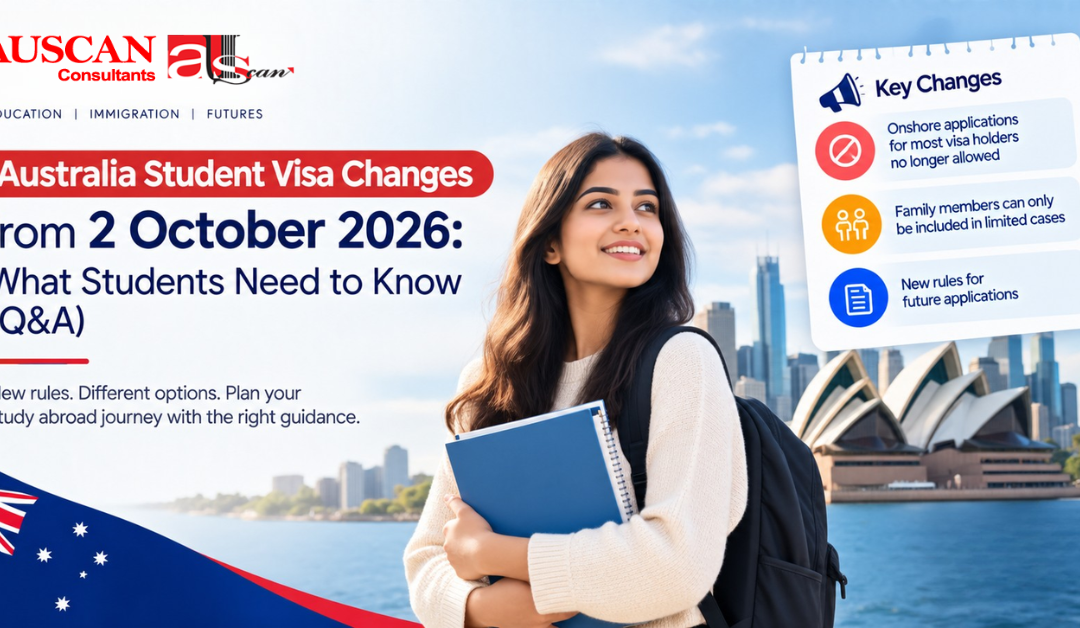
From 2 October 2026, most people already in Australia can no longer apply for a Student visa (subclass 500) onshore, and most students can no longer bring a partner or children with them. These are the biggest changes to Australia’s student visa rules in years, announced by the Department of Home Affairs.
If you are planning to study in Australia, already studying there on a Student visa or hoping your family can join you, read this before you enrol, book travel or lodge an application. Below the AUSCAN team breaks down what has changed and answers the questions we are hearing most often.
The short version for students in India : These reforms make planning more important but they are not a ban on Indian students studying in Australia. What matters is where you apply from, which visa you hold now, your course and whether you want your family with you.
The key changes at a glance
The reforms change three things:
| What changed | Before 2 October 2026 | From 2 October 2026 |
| Applying for a Student visa while in Australia | Holders of many temporary visas (e.g. Working Holiday, Skills in Demand, Training) could switch to a Student visa onshore | Most temporary visa holders must apply from outside Australia |
| Applying for another Student visa in Australia | Student visa holders could generally apply for a further Student visa onshore | Not allowed unless one of six exemptions applies |
| Including or adding family members | Partners and dependent children could be included, or added later as subsequent entrants | Family can only be included if an exemption applies; adding family after grant is no longer possible, with no exemptions |
Applications lodged before 2 October 2026 are not affected. They will be assessed under the old rules, including any family members already in them.
Will the new rules affect Indian students?
For most students applying from India, the application route stays the same: you apply from outside Australia, as before. The restrictions on lodging onshore mainly affect people who are already in Australia on another visa, or existing students who want a new Student visa without leaving.
The bigger change for Indian families is around dependants. India is not a Pacific Island or ASEAN country, so most Indian students can only include a spouse or children if they are studying a PhD, are sponsored by DFAT or Defence or hold a fully funded foreign government scholarship. Because family can no longer join you later, decide on family plans before you apply.
If you are already studying in Australia, your next visa needs more care. Changing provider, dropping to a lower-level course, or extending your studies can decide whether you can apply onshore or must return home to apply.
Your questions answered
For students applying from India
Q: Can Indian students still apply for an Australian Student visa after 2 October 2026?
Yes. There is no blanket ban on Indian students. If you apply from India and meet the usual visa requirements (genuine student, English, financial capacity, health and character), the onshore restrictions do not stop you.
Q: Should I change my study plans because of these reforms?
Not necessarily. Your decision should rest on your study goals, course choice, budget and individual visa eligibility. What has changed is that your first course choice matters more, because it shapes which exemptions you can use later.
Q: I’m in India and want to bring my wife or husband. Can I?
Only if an exemption applies. For most Indian students, that means studying a PhD, being sponsored by DFAT or Defence, or holding a fully funded foreign government scholarship. If you qualify, your family must apply with you, from the same location, at the same time.
Applying from inside Australia
Q: I’m in Australia on a Working Holiday visa. Can I still switch to a Student visa?
No, not from inside Australia. From 2 October 2026, holders of these visas can no longer apply onshore: subclass 400 (Short Stay Specialist), 407 (Training), 408 (Temporary Activity), 417 (Working Holiday), 462 (Work and Holiday), and 482 (Skills in Demand), including the older 482 (Temporary Skill Shortage) and 457. You will need to apply from outside Australia.
Q: What about Visitor, ETA or Temporary Graduate (485) visa holders?
They were already unable to apply onshore, and that has not changed. The same applies to subclasses 403 (Domestic Worker – Diplomatic or Consular), 485, 600, 601, 651, 602, 771 and 988.
Q: If I must apply offshore, can I fly back to Australia while I wait?
Yes, on another valid visa, but you must leave Australia again before your Student visa can be granted. You must be outside Australia both when you lodge and when the visa is granted. You also won’t receive a Bridging Visa A for that application.
Q: Does this affect the Student visa I already hold?
No. Your current Student visa and its conditions are unchanged. The new rules only apply to new applications.
Applying for another Student visa
Q: I’m already on a Student visa. Can I apply for a new one in Australia?
Only if you fit one of six exemptions:
- Course completion: you need up to 12 more months beyond your original course end date to finish your main course, with the same education provider.
- Government sponsorship: you are sponsored by DFAT or the Department of Defence.
- PhD: you are applying to study a Doctoral degree. This does not cover Masters by Research.
- School studies: you are applying for primary or secondary school.
- Course progression: you have completed your main course and are moving up to a higher AQF level course (details below).
- Provider default: you cannot continue because your education provider has defaulted.
Q: I failed subjects and want to finish my degree at a different university. Does the course completion exemption apply?
No. Home Affairs gives this exact example: a student whose Bachelor of Business CoE ended in June 2027 enrolled at a different university to finish by June 2028. That application was invalid, because the exemption only covers finishing with the same education provider.
Q: How does the course progression exemption work?
You must have completed your main course (the one your visa was granted for) and be moving to a course at a higher AQF level. A few rules matter:
- If you finished a higher education course, your next course must also be higher education, at a higher education provider.
- If you finished school, you can progress to a course without an AQF level.
- If you finished a non-AQF course such as ELICOS (English), your next course must have an AQF level. For example, ELICOS to a Bachelor degree qualifies.
Q: I switched from a Bachelor degree to a VET Diploma and completed it. Can I now apply onshore for a Bachelor?
No. Home Affairs says this is invalid. The Diploma (AQF 5) was not the main course your visa was granted for, and it is a lower level than the original Bachelor (AQF 7). Progression only works if you completed your main course, or a course at the same or higher AQF level.
Q: I’m on my partner’s Student visa as a dependant. Can I apply for my own Student visa in Australia?
No. Secondary Student visa holders can no longer apply as a primary applicant onshore. You would need to apply from outside Australia.
Family members
Q: Can I include my partner and children in my Student visa application?
Only if you fall into an exemption. Exempt students can include any family members, even ones not on a previous visa, if they are:
- studying a PhD (not Masters by Research)
- sponsored by DFAT or Defence
- receiving a fully funded foreign government scholarship
- a national of a Pacific Island or ASEAN country (only the main applicant needs to be)
Note that foreign government scholarship holders and Pacific/ASEAN nationals must still apply from outside Australia, unless an onshore exemption also applies.
Q: My family is already on my current Student visa. Can they stay on my next one?
Possibly. If you qualify for the course completion, provider default or course progression exemption, you can include family who were on your previous Student visa. You cannot add anyone new. For course progression, this only applies to onshore applications by students who applied for or held a Student visa before 2 October 2026.
Q: Can my family join me later, after my visa is granted?
No. Adding family members as subsequent entrants is no longer possible, and there are no exemptions to this rule. If you want your family with you, they must be included when you apply.
Q: Do my family members need to be in the same place when I apply?
Yes. You and all family members in the application must be in the same location, inside or outside Australia, when it is lodged.
After lodging and invalid applications
Q: Will I get a Bridging Visa A?
It depends on where you apply and whether you are eligible to apply onshore:
| Your situation | Bridging Visa A? | Where you must be at grant |
| Eligible, applied inside Australia | Yes, granted on lodgement | Inside or outside Australia |
| Eligible for onshore, but applied outside Australia | May be eligible | Can be inside Australia |
| Not eligible onshore, so applied outside Australia | No | Must be outside Australia |
Q: What happens if I apply in Australia when I’m not eligible?
Home Affairs will treat the application as invalid. This is serious: an invalid application may affect your visa status, you may be unable to apply for another visa if your current one has expired, and invalid decisions cannot be reviewed at the Administrative Review Tribunal (ART). If you are unsure whether an exemption applies, get advice before you lodge.
Q: I lodged before 2 October 2026. Am I affected?
No. Applications lodged before that date, including those with family members, are assessed under the old rules.
What’s coming next
Home Affairs has flagged two more stages of reform:
- limits on Temporary Graduate (subclass 485) applicants including family members
- a new “transfer” stream of the Student visa for students moving to a new education provider while in Australia
Details have not been released yet. We will update this post as more information comes out.
Advice from AUSCAN’s directors
AUSCAN’s directors Sunil Jaggi (Managing Director, MARA Registered Migration Agent, MARN 0429029) and Divya Jaggi (Director, MARA Registered Migration Agent, MARN 1807587) stress that the same rule change can affect two students very differently. Your current visa, location, course, education provider, AQF level and family situation all matter.
Over the past two decades four to five years, AUSCAN has mainly helped single Indian students. For them the dependant restrictions will have little direct impact and the family-related reforms should not be read as a general limit on their eligibility to study.
Their practical advice:
- Decide on family before you apply. A spouse or children cannot be added once your visa is granted, with no exceptions.
- Choose your main course carefully. It decides whether you can later use the course completion or course progression exemption onshore.
- Get advice before changing provider or course. Moving to another provider or to a lower AQF level, can cost you the right to apply in Australia.
- Never lodge onshore unless you are sure an exemption applies. An invalid application can damage your visa status and cannot be reviewed at the ART.
- Plan travel around the grant. If you must apply offshore, you must also be outside Australia when the visa is granted.
In the directors words choose your course carefully, understand your visa options, prepare your documents properly, and seek professional guidance before making any decision that could affect your immigration status.
Planning to study in Australia? Contact AUSCAN Consultants to have your situation assessed by a MARA Registered Migration Agent before you enrol, travel or lodge.
This article is general information based on Department of Home Affairs material about the reforms that started on 2 October 2026. It is not legal or migration advice for your situation. Eligibility and outcomes depend on your individual circumstances and the rules in force when you apply. Visa rules can change, so always check the official Subclass 500 Student visa page.